
Spatenbräu 1 Liter Brewery Stein
By: Walter Swett
Description
In this article we will examine a one-liter Spatenbräu stein and its markings, then trace the history of the Spatenbräu brewery from its founding in 1397 to its acquisition by Interbrew.
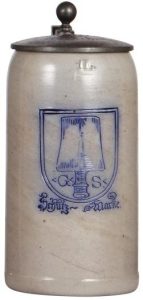
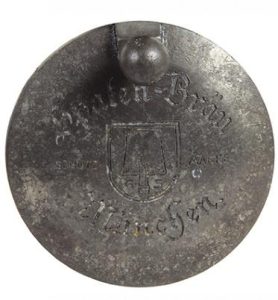
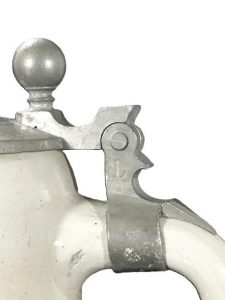
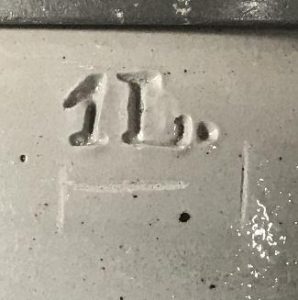
This one-liter Spatenbräu stein has an unknown maker. It has a five-pin, open hinge with an impressed “L” on the left side of the hinge shank, a style that had become the hinge of choice by 1895. The central scene is the Spatenbräu trademark, designed by Otto Hupp in 1884, which includes a malt spade and the initials “G.S.” for Gabriel Sedlmayr. The lid also displays an impressed copy of the trademark with “Spatenbräu München” around it. The symbol “1L” is centered on the front of the stein and was impressed before the stein was fired. Beneath it is the fill line, or “Füllstrich,” which was added after firing. In 1885, Bavarian regulations began requiring commercial drinking vessels to carry a quantity mark and a “Füllstrich.” Because firing shrinkage made pre-fired Füllstrich marks inaccurate, steins had to be re-marked afterward. To avoid this double marking, manufacturers impressed the quantity mark (1L) before firing and added the Füllstrich after. By the end of the 1880s, changes in manufacturing processes had overcome the problem and eliminated the need for manual marking of the steins.
The trademark on this stein belongs to one of Munich’s oldest and most influential breweries, whose history is outlined below.
Spatenbräu traces its history to a small brewery founded by Hans Wesler in 1397 at 4 Neuhauser Strasse, Munich. In 1622, Georg Spät, owner of the rival Unterspatenbräu, took control of it and renamed it Oberspatenbräu. Gabriel Sedlmayr acquired it in 1807 and quickly brought innovations such as steam-roasted malt and thermometer-monitored temperatures, which spurred rapid growth. The Unterspatenbräu closed in 1822, and by 1827 Sedlmayr had opened a second brewery and become one of Munich’s leading brewers. After his death in 1839, the business passed to his sons Gabriel Jr. and Joseph; in 1841 Joseph split off and took control of the Leistbräu. Gabriel Jr.’s three sons took over daily operations in 1874, and in 1884 the artist Otto Hupp created the now-famous Spatenbräu logo. Although Gabriel Jr. died in 1891, Spatenbräu was the largest brewery in Munich by the late 19th century. Through the early 1900s it expanded, exporting to England and the United States and introducing new products, including Munich Hell beer, which other brewers soon copied. In 1922, the companies of Gabriel Jr. and Joseph merged as Gabriel & Joseph Sedlmayr Spaten-Franziskaner-Leistbräu AG, which immediately entered a cooperation agreement with Löwenbräu. Exports stopped during WWII, when Allied bombing severely damaged the brewery, and did not resume until 1950. In 1997 Spaten merged with Löwenbräu, and seven years later Interbrew, the German subsidiary of InBev, acquired it.
References:
-
McGregor, John. Pewter Fittings Through the Ages. Retrieved 05.25.2022 https://stein-collectors.org/library/articles/pewter/pewter%20fittings.html
-
Ruebensaal, S. (1999). Der Bierkrug-von der bayrischen Mass zum deutschen Liter. In Das Münchner Kindl…eine Wappenfigur geht einege Wege. (pages 62-67).
-
https://oktoberfest-guide.com/magazine/history-munich-spaten-brewery/ Retrieved 05.25.2022
-
Munich Beer Gardens | Spaten Brewery history Retrieved 05.22.2022
Featured Stein – more than 200 short articles about specific steins.
