
Musician’s Sängerfest Stein
By: Frank C. Glazer
Description
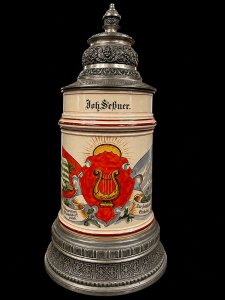
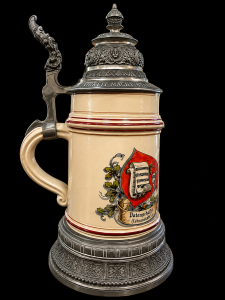
This month’s Stein is an antique German occupational or commemorative lidded beer stein featuring musical motifs and a personalized or dedicated name. As I collect Steins with some direct personal connection to me; I played the violin all through grade school, Jr & Sr High School.
The top banner reads “Joh. Seßner.” (Johann Seßner), which typically indicates the original owner, musician, or member of a local club (Singverein or music/choral society).
Center Design: A prominent red shield/crest centered with a golden lyre, flanked by musical or symbolic artwork (such as a swan and sheet music pages).
This is a particularly interesting German beer stein. Based on the inscriptions, decoration, and elaborate pewter work, I believe a commemorative German Sängerfest (Singing Festival) stein dating to approximately 1890, with a strong connection to German musical and choral traditions.
What makes this stein especially interesting is that it appears to combine three themes: German music, patriotic symbolism, and an individual named owner.
1. Identification and Dating
Probable identification:
-
Type: German commemorative / Sängerfest stein.
-
Date: Approximately 1890.
-
Location associated with the stein: Düsseldorf, Germany.
-
Named individual: Joh. Seßner.
-
Body: Decorated ceramic or stoneware.
-
Mountings: Elaborate pewter lid and base.
-
Subject: Music, singing societies, and German patriotism.
The date is particularly significant because the front explicitly identifies the Düsseldorf Sängerfest of 1890.
2. The Front of the Stein
There are several important inscriptions.
Joh. Seßner
This appears to be the name of the original owner.
“Joh.” is an abbreviation for Johann or Johannes.
It is possible that Johann Seßner was a member of a singing society that participated in the 1890 festival.
Sängerfest Düsseldorf 1890
German Sängerfeste were important social and cultural occasions. Singing societies from different communities gathered for concerts, competitions, parades, and celebrations.
The German choral movement also had strong patriotic associations.
Zur fröhlichen Einkehr
Translation: For a cheerful gathering or a pleasant stop at the inn.
This is a traditional expression associated with fellowship and conviviality.
3. The Musical Emblems
The central red shield contains a golden lyre.
The lyre is a traditional symbol of music, poetry, and artistic accomplishment.
The other decorations reinforce the musical theme.
Notice the elaborate sunburst behind the shield.
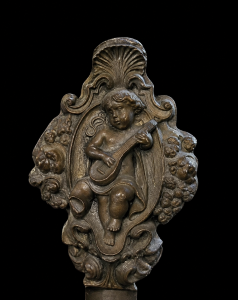
The combination of the lyre, musical imagery, and cherub playing a stringed instrument on the lid’s thumb lift makes this a particularly attractive musical-themed stein.
4. The Reverse Side
There are two particularly interesting details.
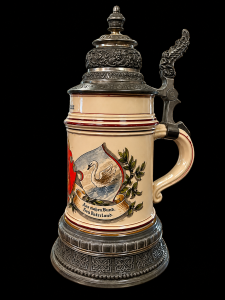
The Swan
The swan appears inside a decorative shield.
Swans were frequently used in German artistic and musical symbolism, representing beauty, poetry, and artistic inspiration.
5. The Pewter Work
This is one of the most impressive features of the stein.
Notice the following:
-
Elaborately decorated pewter lid.
-
Ornate hinged thumb lift.
-
Cherub playing a stringed instrument.
-
Raised floral and scrollwork decoration.
-
Large decorative pewter foot.
-
Engraved geometric patterns around the base.
The cherub playing an instrument is particularly appropriate for a musical commemorative stein.
6. The German Inscription on the Lid
One inscription deserves special attention:
Einigkeit macht stark!
Translation:
“Unity Makes Strength” or more naturally, “Unity Is Strength.”
This was a popular German patriotic and organizational motto.
It is particularly appropriate for a Sängerfest because singing societies emphasized fellowship, cooperation, and German cultural identity.
The German choral movement had strong connections to civic and national identity. The historical account published by the Chorverband Düsseldorf discusses these traditions. Chorverband Düsseldorf
7. Historical Significance
The year 1890 places this stein in an interesting period of German history.
Germany had been unified under the German Empire since 1871.
German singing societies were important cultural organizations. Their festivals brought together people from different communities and celebrated German music, language, and traditions.
Düsseldorf had a particularly active musical and choral tradition dating back to the nineteenth century.
The stein appears to commemorate that tradition.
Featured Stein – more than 200 short articles about specific steins.
 STEIN COLLECTORS