


Reservist Steins: Authentic vs. Reproduction
By: Walter Swett
Description
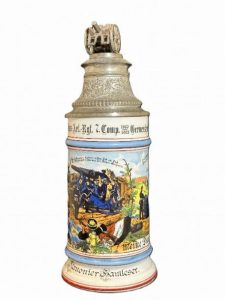
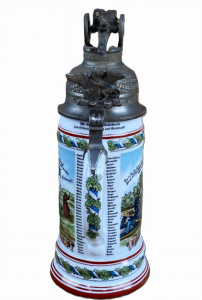
New collectors of Reservist Steins often ask the same question: How do I tell the difference between an authentic stein and a reproduction? To help answer it, here is a side-by-side comparison of two 2. Fuss Art. Rgt. (Königlich Bayerisches 2. Fussartillerie-Regiment) steins. The authentic one is from 7th Company, Germersheim. The reproduction is purportedly for the 7th Company in Metz. Both are dated 1900/1902.
An additional original for 12. Comp. can be found in R. Ron Heiligstein’s book “Regimental Beer Steins”, page 240-241, item 211 and photos 211a-c. The images of the reproduction stein were found online from an auction held on October 4, 2020.
Photo 1a is of the original and 1b is the reproduction.
1a 1b

The differences discussed below are lid coloration, oakleaf decoration, sharpness of detail, and handle features, including the maker’s stamp.
To me, the most obvious difference is the coloration of the lids. The original is lighter in color with a more natural appearing patina. The reproduction has a uniform, dark, patina indicative of a chemically aged lid.
The second feature that flags the reproduction for me is the excessive oakleaf decoration. Excessive oakleaf clusters like these were not found on originals.
Although oakleaf decorations can be found on original Regimentals, they are different than the excess oakleaf clusters shown in Figure 1b. My recommendation is to familiarize yourself with what the original oakleaf decorations look like from a reliable source, so you can then identify what I refer to as “excessive oakleaf decorations” here.
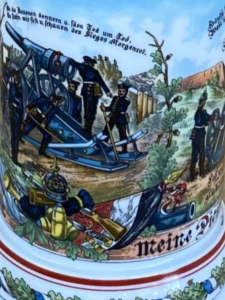
Finally, the details on the original are much sharper. Buttons and other details have generally been highlighted by hand painting on the original. Be careful, though: although rare, some later reproductions have added enameled details.
Photos 2a and 2b show the differences in detail between the original and the reproduction. The colors of the original are more vibrant. In 2a, among other things, one can see greater detail on the helmet, flags, uniforms, and cannon. If you run a finger over the image, you can feel the enameling of the highlights.
Photo 2a is of the original and 2b is the reproduction.
2a 2b

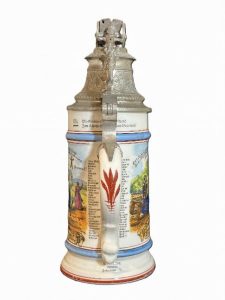
Handle decorations are another feature to closely examine. Photo 3a shows an original design while 3b shows a frequently encountered excessive oakleaf design. Although not present on most Regimental Steins, this original has the stamp of the finishing firm beneath the handle. It is missing on the reproduction.
Photo 3a is of the original and 3b is the reproduction.
3a

3b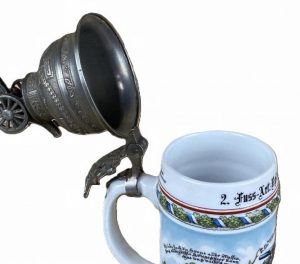
An original interior of the lid will normally still have much of its original shine, as seen in Photo 3a. The shine has been retained over the years because the lid has not had regular exposure to air. Photo 3b shows the uniform dark patina, both inside and out, confirming that the lid was chemically aged.
Many reproduction steins have a bump in the handle, this one does not. Just because there is no bump in the handle, that is not confirmation that the stein is not a reproduction.
Photo 4a is of the original and 4b is the reproduction.
4a 4b
The differences noted here are not the only ones that may be present but are some of the most frequently encountered. My advice for beginners is to familiarize yourself with what original Regimental Steins look like. In my opinion the best way to do that is join Stein Collectors International where you will have access to the vast research library of Prosit, a group of collectors willing to share their knowledge, and the opportunity to attend chapter meetings where you can handle a variety of steins, to include Regimentals.
Featured Stein – more than 200 short articles about specific steins.
 STEIN COLLECTORS