


A Cyclist’s Stein and an Honest Pour
By: Chris Gatz
Description
As someone who enjoys both cycling and collecting beer steins, I can easily picture this one on a table outside a German inn around 1900. The club has just finished its Sunday ride, the bicycles are leaning against the wall, and everyone is ready for a freshly poured beer. I imagine the conversation would sound pretty familiar to anyone who rides today. Who picked that route, and how come nobody mentioned the last hill?
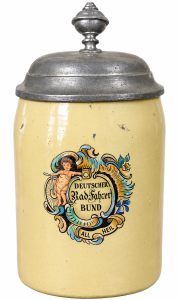
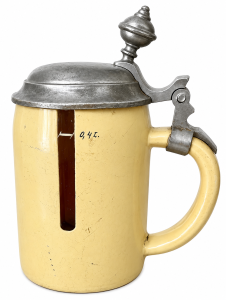
What I like about this stein is how well it was designed for everyday use. At first glance, the cream-colored body looks like stoneware. It has a comfortable-looking handle, a simple pewter lid, and the colorful emblem of the Deutscher Radfahrer-Bund (German Cyclists’ Association) on the front. Turn the stein to the side, though, and you can see what makes it interesting. The body is clear glass coated with cream-colored enamel, with a narrow strip of glass left exposed on each side.
Take a close look at the side photo. Near the top of the window, you’ll see a short line marked “0,4 L.” That little window gave the cyclist a way to check his pour. Once the foam settled, he could see whether the beer reached the four-tenths-liter mark. With a window on both sides, I suppose his riding buddy across the table could check it for him, too!
The association was founded in Leipzig in 1884. Its members organized races and club rides, and regional groups published touring guides to help cyclists find their way. Some guides even identified inns where members could get a special rate. That’s a membership benefit I could still use today! On the ribbon below the emblem are the words All Heil!, a greeting cyclists used to wish one another a safe ride.
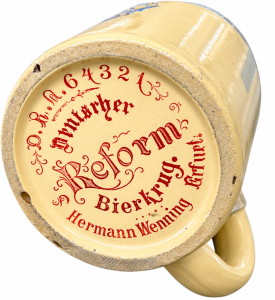
The underside of the stein gives us another part of the story. The red lettering identifies it as a Deutscher Reform Bierkrug and names Hermann Wenning of Erfurt. Steve Breuning and I included this stein in our article on German cycling club steins in the December 2024 issue of Prosit. We dated it to about 1900 and traced the Wenning firm back to 1871. I was curious about what else the company made. A 1930–31 German glass-industry directory lists honey jars, medicine bottles, and even caviar jars among its products. It also tells us the Erfurt shop had facilities for painting and firing glass.
I’d enjoy knowing who first owned this stein and where his club liked to stop after a ride. Did he bring it along for the outing, or did the innkeeper have it waiting for him? Those are the kinds of questions that keep me interested in collecting. And if I could join those cyclists for an afternoon, I’d gladly buy the first round. I’d just want to see which fellow checked the line first. Prosit!
Featured Stein – more than 200 short articles about specific steins.
 STEIN COLLECTORS