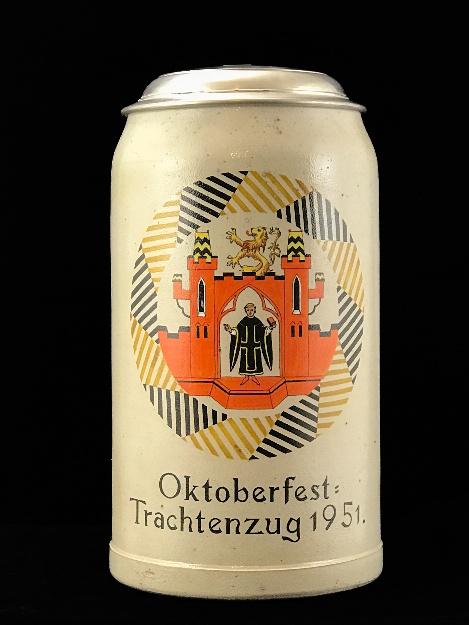
This 2-liter stein commemorates the 1951 Oktoberfest Trachten und Schützenzug (traditional costume and marksmen parade) and represents one of the larger presentation pieces associated with that year’s participating groups.
The central scene depicts the pre-1936 large coat of arms of the City of Munich, while the black-red-gold colors reflect the national colors adopted in Article 22 of the German Basic Law in 1949.
The inscription on the back, “Erinnerungsgabe der Stadt München,” translates as “A souvenir from the City of Munich.”
Based on confirmed markings on a 1-liter version, this stein is believed to have been produced by AGWW Aktien Gesellschaft Wick Werk.
The inside of the lid is stamped with the mark of Munich pewterer Max Rackl: “M. RACKL MÜNCHEN.”
The parade history provides useful context for the stein’s commemorative purpose and helps explain why presentation pieces from the 1951 event are collectible today.
The Trachten und Schützenzug traces its history to 1835, the 25th anniversary celebration of the marriage of King Ludwig I and Therese of Bavaria and the 25th Oktoberfest.
The first parade celebrating Bavarian culture and daily life included 86 floats and more than 1,000 participants wearing traditional Bavarian clothing, together with sharpshooters.
Although held several times over the years on special occasions, the Trachten und Schützenzug did not become an annual event until 1948, when it appeared at the scaled-down Fall Festival.
In 1949, the fest returned in a recognizable form as Oktoberfest and opened with the Trachten und Schützenzug, featuring 123 groups from Munich and Upper Bavaria.
Participation by sharpshooters was still absent at that time because it had been prohibited by the military occupation government.
The tradition has continued annually since then. Recent Trachten und Schützenzug parades have involved more than 9,000 participants and over 250,000 spectators.
Sources:
Oktoberfest, Landeshauptstadt München, https://tinyurl.com/yvfnvxzc, retrieved November 30, 2025.
Bauer, R., & Fenzl, F. (1985). 175 Jahre Oktoberfest 1810–1985. Bruckmann, Munich.
Steinmarks, “Rackl & Eisenmann / Max Rackl Zinngießerei,” retrieved November 30, 2025.
